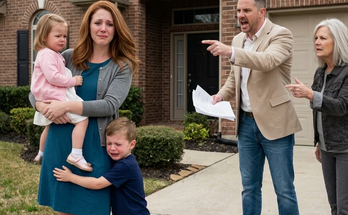
I looked at him for several moments.
Throughout our marriage, I had often found myself second-guessing my feelings whenever Daniel disregarded something important to me.
He had frequently characterized my concerns as unreasonable and made ordinary requests for consideration seem selfish.
Now he was treating my decision to contact the authorities as the central problem.
Not the fact that he had entered without permission. Not the moving vehicle parked outside. Not the furniture that had already been arranged throughout my home.
Instead, he focused on the telephone call.
My thoughts returned to the many difficult discussions we had experienced during our years together.
I remembered apologizing on occasions when I simply wanted a disagreement to end.
I remembered setting aside my own preferences because I worried that asserting myself might create further tension in our marriage.
And I remembered the extraordinary sense of relief that accompanied the finalization of our divorce.
“I did talk to you,” I said. “I spent years trying to explain what respect meant. Today, I chose to protect my property instead of arguing about whether I had the right to do that.”
Daniel turned his eyes away.
For once, he seemed unable to find an immediate reply.
Vanessa remained a short distance behind him.
I couldn’t determine whether she had accepted Daniel’s account without question or had only begun to understand that the circumstances were different from what she expected.
I chose not to question her about it.
Whatever she understood about Daniel’s actions was something she would have to address herself.
His discomfort was not mine to resolve, either.
My priorities were securing the property, preserving accurate records, and ensuring that any remaining issues were handled through suitable channels.
That evening, Rachel remained with me as I organized the paperwork and reviewed the recordings from the security cameras.
I updated the entry codes, inspected the locks, and contacted the security provider to determine whether any additional users had been granted access.
I also arranged for a more thorough security review to make sure that no unapproved keys or electronic credentials could still be used.
Eventually, the rooms became peaceful again.
The furniture had either been taken away or was subject to arrangements for its removal, allowing me to begin evaluating what needed to be restored before I could settle comfortably.
I sat at the kitchen counter, holding a warm cup of coffee.
The room where I had once imagined enjoying calm mornings now carried an entirely different feeling.
It wasn’t because Daniel had successfully taken my independence away.
Rather, I had discovered how quickly someone might disregard a boundary when they expected me to remain uncertain about defending it.
For years, I had mistaken remaining quiet for maintaining harmony.
I had convinced myself that avoiding disagreements was the best way to preserve a peaceful future.
That Saturday changed my understanding.
Sometimes, maintaining peace requires standing by a decision when another person has already disregarded your wishes.
At other times, it requires preserving evidence, seeking assistance, and allowing qualified authorities to address a problem rather than attempting to settle everything through a personal disagreement.
And sometimes, the most meaningful response doesn’t involve an emotional confrontation or a lengthy speech.
It can be as simple as making the appropriate telephone call when you recognize that something needs immediate attention.
Eleven Days After Beginning Again
Over the following weeks, I became increasingly thoughtful about the people who could obtain information about my personal affairs.
I examined my accounts, verified the property records, and carefully retained the paperwork associated with what had occurred.
I also established that any necessary future communication with Daniel would remain limited to relevant matters and take place through suitable channels.
I couldn’t determine whether his actions had been driven by a sense of entitlement, difficult personal circumstances, or a mistaken assumption that our previous marriage still gave him some authority over my property.
Understanding his precise reasoning wasn’t necessary for me to recognize that my boundaries had been disregarded.
The property still belonged to me.
The ownership deed remained exactly as it had been.
I had never needed Daniel’s approval to purchase the house, and my right to live there was independent of whether he accepted my decision.
Gradually, I returned to the plans I had been making before that unexpected Saturday.
I gave the upstairs bedroom a fresh coat of paint. I measured the kitchen walls once more for the shelves I wanted. I purchased a used desk for my office and positioned it near the window, where gentle morning sunlight brightened the floor. I placed a small potted plant on the porch.
None of these changes was particularly extraordinary, but each carried a special meaning for me.
Every small choice reminded me that I could shape my surroundings without seeking Daniel’s opinion.
My decision to purchase the property had never been about demonstrating anything to my former husband.
I had bought it because I wanted to establish a future of my own.
And regardless of that difficult experience, the possibility of building that future remained.
Sometimes, when I think back on that day, I remember the instant my phone vibrated in Rachel’s kitchen.
Had I dismissed the security notification, I might have remained unaware of what was happening until much later.
Had I contacted Daniel before seeking assistance, I might have spent valuable time debating the situation while more belongings were carried indoors.
There is no way to know precisely what might have happened if I had responded differently.
What I do know is that preserving the footage and contacting the authorities allowed me to address the circumstances without depending entirely on Daniel’s explanations.
That choice made a meaningful difference.
It wasn’t because the call guaranteed any specific outcome under the law, but because it helped me focus on documented events instead of accepting someone else’s interpretation of them.
Our divorce had shown me that ending a marriage doesn’t necessarily erase the habits and expectations that developed during it.
Sometimes, the greatest challenge begins afterward, when you must gradually rebuild confidence in your own decisions.
You have to recognize that refusing a request doesn’t automatically make you unkind.
You have to understand that keeping personal matters private isn’t the same as being dishonest.
And you have to accept that safeguarding your belongings and your boundaries isn’t an attempt to punish anyone.
It is a way of respecting yourself.
Eleven days after becoming a homeowner, I had expected my main concerns to involve selecting paint shades and putting furniture together.
Instead, I watched my former husband arrive with a moving truck and attempt to settle into a house that wasn’t his.
His decisions were beyond my control.
I couldn’t determine what explanation he had given Vanessa.
And I couldn’t make him acknowledge whether his conduct had been inappropriate.
But my own response remained within my control.
I could keep the security recordings. I could seek appropriate assistance. I could communicate my boundaries clearly.
And I could decide that the man I had divorced would no longer determine the direction of my future.
My home represented something far greater than walls, windows, and a roof.
It was the first property I had purchased entirely on my own after spending years trying to preserve a marriage.
It symbolized the simple freedom to close my front door, enjoy a peaceful morning, and make personal decisions without wondering whether another person would approve.
Daniel’s unexpected arrival had temporarily disrupted that feeling of security.
Yet the experience also helped me understand something important.
Even after someone is no longer part of your daily life, they may still expect to have influence over the space you are working to reclaim.
What matters is whether you continue allowing that expectation to shape your choices.
I had finally reached the point where I was ready to stop doing so.
And when my security system sent another notification, I knew I would respond with greater confidence in my ability to safeguard the home I had worked so hard to purchase.
Because the most meaningful lesson from that Saturday wasn’t simply that Daniel could appear at my door without warning.
It was the realization that his decisions no longer had to determine what happened next in my life.