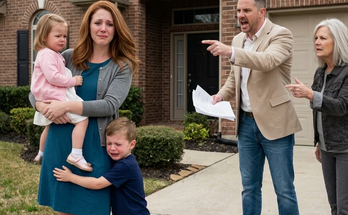
“You gave me their names!”
Daniel shook his head.
“You’re confused.”
For the first time, Lydia appeared uncertain rather than confident.
I began questioning whether she’d actually been controlling the entire arrangement.
Perhaps someone else had been directing her.
That evening, Owen and I settled the girls back into our condominium.
Mom, Lydia, and Daniel had left after agreeing to address the disputed paperwork through legal counsel.
Leah took her sons to a nearby hotel.
Before leaving, she quietly asked whether we could speak privately the following morning.
I agreed.
I trusted none of them, but Leah’s expression suggested she had concerns of her own.
During dinner, June barely touched her macaroni and cheese.
“Mommy?”
“Yes, sweetheart?”
“Are those people mad at us?”
My chest tightened.
“No.”
“Then why did Grandma look so angry?”
I exchanged a glance with Owen.
How could I explain decades of difficult family relationships to a six-year-old?
I lifted June onto my lap.
“Sometimes grown-ups make choices that hurt other people. And sometimes they get upset when someone tells them those choices were wrong.”
June considered my explanation.
“Like when Sadie colors on the wall?”
I smiled faintly.
“A little like that.”
Sadie looked offended.
“Wall was boring.”
Owen laughed.
For a brief moment, the tension disappeared.
After putting the girls to bed, I stood beside the living room windows.
The lake was dark, with distant lights reflecting across the water.
Owen approached and wrapped his arms around me.
“You’ve been quiet.”
“I keep thinking about Dad.”
He rested his chin on my shoulder.
“I know.”
“I spent seven years wondering what he wanted to tell me.”
“Mara.”
“What if it was this?”
Owen remained silent.
I turned toward him.
“What if he knew someone was using our family to steal property? What if he was trying to warn me?”
“We don’t know that.”
“No. We don’t.”
I covered my eyes.
“But I didn’t answer his call.”
Owen gently lowered my hands.
“Listen to me. You couldn’t have known what would happen the next day.”
I shook my head.
“That doesn’t make it easier.”
He kissed my forehead.
“Then we’ll find out what he was trying to say.”
I studied his face.
“How?”
He considered the question.
“Start with the people who worked with him.”
Immediately, I thought of Carol Winters.
Dad’s former colleague.
The notary whose expired commission appeared on the suspicious trust documents.
Then I remembered something Dad had once said about her.
Carol never discarded important records.
“Old paper has a way of telling the truth,” he’d said.
I picked up my phone and searched for her contact information.
Carol Winters lived in a tidy little house outside Oregon City.
She was seventy-two, with short gray hair and observant blue eyes.
When I introduced myself the next morning, her face softened.
“Thomas’s girl.”
I nodded.
She opened the door wider.
“Come in.”
Priya accompanied me.
We sat at Carol’s kitchen table as she poured coffee into mismatched mugs.
After asking about my career and family, she watched me place the trust amendment before her.
Her smile v@nished.
“Where did you get this?”
“My sister.”
Carol examined the signature and notarial stamp.
Her hands began trembling.
“I didn’t notarize this.”
Priya leaned closer.
“You’re certain?”
“My commission expired in 2025. I retired before that.”
“Could someone have had access to your seal?”
Carol glanced toward the window.
After a long silence, she answered.
“I lost it.”
“When?”
“Last winter. I thought I’d misplaced it during a move.”
“Did you report it?”
“Yes.”
Priya and I exchanged concerned looks.
Carol retrieved a folder containing the report she’d filed about her missing seal.
Its date coincided with the early preparation of the disputed financing documents.
I felt increasingly uneasy.
“Carol, did my father ever talk to you about Lydia’s business?”
Her expression immediately changed.
I already knew the answer.
“Thomas was worried,” she admitted.
“About what?”
She studied her coffee.
“He thought somebody was using elderly people’s names on property documents they hadn’t authorized.”
Priya became attentive.
“Identity fraud?”
Carol nodded.
“He found irregularities involving several transfers. Some owners had died. Others were in assisted living facilities.”
“Did he report them?”
“He was gathering evidence.”
My chest tightened.
“What happened?”
Carol hesitated.
“Your father came to see me three days before his accident.”
I stared at her.
“He brought a folder. Said he was afraid someone inside the family had become involved.”
“Who?”
She shook her head.
“He wouldn’t say.”
“Carol, please.”
Her eyes filled with tears.
“He told me he had confronted someone and things had gotten ugly. He said the person was desperate and that desperate people made dangerous decisions.”
I struggled to process her words.
“Did he leave the folder with you?”
“No. He took it.”
“Do you know where it went?”
Carol watched me silently before retrieving a small wooden box from the living room.
Several letters lay inside.
The top envelope carried my name in Dad’s familiar handwriting.
Mara.
I reached toward it, but Carol gently stopped me.
“Thomas asked me to give you this only if something happened that made you question his death or the documents connected to it.”
My throat tightened.
“Why didn’t you contact me?”
“Because he said you’d know when you needed it. And I didn’t understand what he meant.”
She handed me the envelope.
With trembling fingers, I unfolded the single sheet inside.
Dad had written on both sides.
I began reading.
My beautiful girl,
If you’re holding this, then someone has done something I hoped they would never have the courage to attempt.
I need you to understand one thing before anything else.
You were never the foolish daughter.
You were the one I trusted to see the truth.
Tears blurred my vision.
I wiped my eyes and continued.
There are transactions connected to our family that are not what they appear to be.
I have kept records because I no longer trust verbal promises.
Someone has been using names, signatures, and property records to move money that does not belong to them.
I confronted the wrong person too early.
That was my mistake.
Do not accept the first explanation you are given.
Especially if it comes from someone who appears to have nothing to gain.
I reread the final warning.
Especially if it comes from someone who appears to have nothing to gain.
Turning the page over, I discovered another instruction.
Ask Carol about the blue ledger.
I looked up.
Carol was crying.
“I hoped I’d never have to show you that.”
“What blue ledger?”
She explained that Dad had privately documented every questionable transaction in a notebook with a blue cover.
“Where is it?”
“I don’t know.”
“But you knew about it?”
She nodded.
“Your father believed it could destr0y someone’s life.”
I swallowed.
“Whose?”
Carol looked frigh.ten.ed.
“I think that’s what got him k!lled.”
By Monday morning, my life felt divided.
In one world, I remained Mara Ellis, attorney, wife, and mother, managing client emails while my daughters argued over breakfast.
In the other, I was examining suspicious property documents connected to my father’s final days.
Priya had notified the appropriate authorities and informed the financing company that the ownership documents were disputed.
The proposed closing was suspended pending further review.
But the situation didn’t end there.
Instead, the pressure intensified.
At 8:17 a.m., Lydia called fourteen times. At 8:43, Mom left a voicemail blaming me for embarrassing Daniel. At 9:12, an unknown number sent a message.
You have no idea what you’re interfering with.
I immediately showed Priya.
She preserved it alongside the other evidence.
Another message followed.
Walk away from the property issue.
Keep your family out of it.
For the first time, I felt genuinely afraid.
Not primarily for myself.
For June and Sadie.
Owen insisted on returning to Seattle with the girls while I stayed in Oregon to assist Priya.
I hated watching them leave.
But when June hugged my neck and asked whether I’d return before bedtime, I knew protecting their peace mattered most.
“I love you,” I whispered.
“Love you more,” she answered.
“Impossible.”
She grinned.
“Double impossible.”
I kissed her forehead.
Then Owen gently held my face.
“You call me if anything feels wrong.”
“I will.”
“Mara, I mean it.”
“I know.”
He kissed me goodbye.
As their car disappeared, I couldn’t escape the feeling that Dad’s discoveries had never truly been resolved.
Whatever he’d uncovered seven years earlier was resurfacing.
That afternoon, Leah met me at a coffee shop near downtown Lake Oswego.
She looked exhausted, wearing jeans and a gray sweater, her hair loosely tied back.
She sat opposite me and placed her phone on the table.
“I need to tell you something.”
I waited.
She twisted her wedding ring nervously.
“Daniel told me our landlord sold our house.”
“I know.”
“He showed me a letter.”
“And?”
Her eyes filled.
“I called the landlord this morning.”
I leaned forward.
“What did he say?”
“He hasn’t sold anything.”
I stared.
“He says our lease is good for another eleven months.”
Neither of us spoke.
Then Leah whispered, “Daniel lied to me about us being homeless.”
A troubling realization began forming.
“Did he explain why?”
She shook her head.
“When I confronted him, he said the landlord was confused and that everything was being handled.”
“Leah, does Daniel actually have financial problems?”
“I don’t know anymore.”
She produced an envelope containing three bank statements and a business credit notice.
“I found these in his desk after he left for work.”
I examined the documents.
Several substantial transfers connected Daniel’s delivery company with Northbridge Administrative Services.
Some payments were labeled consulting or fleet development.
The amounts seemed unusually high for routine administrative services.
Then one transfer caught my attention.
$186,400.
The receiving account was associated with the Ellis Family Continuity Trust.
I studied the figure.
“Leah, where did Daniel get this money?”
She shook her head.
“I thought he was struggling.”
“Did he tell you that?”
“Every day.”
She began crying.
“He made me feel guilty for buying new school shoes for Noah. He said we might lose everything.”
I reached across the table and touched her hand.
She wiped her eyes.
“Then Lydia called and said you were letting us move into the condo. Daniel acted like it was the first good thing that had happened in months.”
I remembered Daniel standing quietly beside my windows.
His nervous gestures, vague answers, and apparent reluctance to argue.
For years, I’d interpreted his silence as a harmless personality trait.
Now I wasn’t certain.
“Leah,” I asked carefully, “who handles the finances in your marriage?”
“Daniel.”
“Who prepares your tax returns?”
“Daniel.”
“Who manages your savings?”
She looked directly at me.
“Daniel.”
My concern deepened.
Perhaps Lydia hadn’t independently decided to offer my condominium. Perhaps someone had persuaded her to participate.
Our first significant breakthrough involved an older property transaction.
Priya spent two days examining public records connected to the trust and financing entities.
Some transactions appeared routine.
Others warranted closer investigation.
Several involved properties previously owned by elderly individuals.
Some transfers occurred shortly before an owner’s de:ath, while others relied on representatives whose authorization was unclear.
One property stood out.
A modest bungalow outside Beaverton had belonged to Eleanor Whitcomb, an eighty-six-year-old woman.
Documents indicated that an agent acting under a power of attorney had transferred the home.
The sale price was below its estimated market value.
The purchasing company also had an indirect connection to Northbridge Administrative Services.
I called Priya.
“Look at the Whitcomb transaction.”
“I’m already looking.”
“Who was the agent?”
“That’s the interesting part.”
“What do you mean?”
“The signature doesn’t match the specimen the family later supplied in a separate probate matter.”
I felt uneasy.
Another potentially unauthorized signature.
Priya continued.
“There’s more. Eleanor’s grandson filed a complaint after her death. He believed she had never authorized the transfer.”
“What happened?”
“The complaint didn’t establish enough to unwind the sale at the time. The company that bought the house had already transferred it again.”
I leaned back.
“How many properties?”
“We’ve identified at least nine worth reviewing. That doesn’t prove fraud in all of them.”
“Nine?”
“Possibly more.”
I looked across the lake.
Nine properties. Nine families potentially affected by questionable transactions. Nine homes that might have represented someone’s entire sense of security.
Dad’s letter returned to my thoughts.
Someone has been using names, signatures, and property records to move money that does not belong to them.
His concerns hadn’t necessarily been unfounded.
He’d been examining transactions that deserved scrutiny.
Meanwhile, Mom had spent his final months suggesting his worries were irrational.
The realization left me deeply unsettled.
That evening, Priya and I met with Detective Rachel Bennett, who was reviewing our report.
She was in her early forties, with dark hair, observant eyes, and a calm, practical manner.
She listened carefully before examining the paperwork.
Then she asked something I hadn’t considered.
“Who had access to your father’s original signature?”
I frowned.
“Everyone in the family, probably.”
“Who had access to his old business files?”
“My mother. Lydia worked in real estate. Daniel sometimes helped Dad move boxes.”
She wrote that down.
“Did your father keep electronic records?”
“Yes.”
“Do you know whether any of his old devices still exist?”
I hesitated.
After Dad passed away, Mom cleared his office, claiming his business records were no longer useful.
I’d asked for his desk, but she’d already donated it.
However, one belonging remained in the family.
Dad’s own briefcase.
Not the secondhand one he’d bought me.
His dark brown leather case with brass buckles.
I’d seen it years earlier in Daniel’s garage while collecting a family photograph.
I looked toward Detective Bennett.
“I know where some of his things ended up.”
“Where?”
“My brother’s house.”
She studied me.
“Do you think your brother is involved?”
I remembered Leah’s tears, the misleading eviction letter, and the unexplained financial transfers.
Then Dad’s warning came back.
Especially if it comes from someone who appears to have nothing to gain.
“I don’t know,” I admitted.
And somehow, acknowledging that uncertainty hurt more than accusing Lydia.
Two days later, Mom arrived unexpectedly.
I was working in a conference room at Priya’s temporary Portland office when the receptionist announced her.
I considered refusing to see her.
Instead, I agreed.
Mom entered without her usual confident posture.
She appeared older and tired, despite her carefully styled hair.
She sat across from me.
For several moments, neither spoke.
Finally, she said, “You’re tearing this family apart.”
I looked at her.
“No, Mom. I’m investigating why someone forged my father’s name.”
She lowered her eyes.
“Your father wasn’t a perfect man.”
“Nobody said he was.”
“He had secrets.”
“So do you.”
Mom’s expression tightened.
“I came here to ask you to stop.”
“Why?”
“Because Daniel has a family.”
“So do I.”
“His children are young.”
“Mine are younger.”
She looked away.
I leaned forward.
“Mom, what happened to Dad?”
She looked up sharply.
“What?”
“The night before he died. He called me. He said he needed to tell me something important.”
“Thomas worried about everything.”
“Why did you tell us he was becoming paranoid?”
“Because he was.”
“Carol Winters says he was investigating suspicious property transfers.”
Mom turned pale.
I watched her closely.
“You knew.”
She remained silent.
“You knew what he was doing.”
Her grip tightened around her handbag.
“Your father was going to ruin everything.”
Her voice was barely audible.
My heartbeat quickened.
“What everything?”
She shook her head.
“People make mistakes, Mara.”
“People make mistakes when they forget appointments or misplace keys.”
I moved closer.
“They don’t accidentally forge signatures on real estate documents.”
Tears filled Mom’s eyes.
For once, she seemed less like the controlling woman I’d known and more like someone overwhelmed by her own decisions.
“Lydia was having trouble,” she whispered.
I waited.
“Her business was losing money. She had borrowed against several properties.”
“Properties she owned?”
Mom hesitated.
“Not all of them.”
My stomach tightened.
“What did you do?”
“I tried to help.”
“How?”
“Your father had savings. I let Lydia use some of it.”
“Without telling him?”
She avoided my eyes.
“Then Daniel said he could move money through his company temporarily. Just until Lydia got back on her feet.”
I went still.
“Daniel?”
She nodded.
“He said he understood financial restructuring.”
I stared at her.
Daniel, the dependable younger brother everyone trusted.
Mom continued.
“Thomas found out. He threatened to go to the authorities.”
My chest tightened.
“And?”
“And we argued.”
“Who argued?”
“All of us.”
I lowered my voice.
“Did Daniel argue with Dad?”
Mom’s expression changed.
“He was upset.”
“About what?”
“He said your father didn’t understand how business worked anymore.”
A terrible possibility began forming.
“What happened after that?”
Mom started crying.
“Your father left.”
“Where was he going?”
“I don’t know.”
“Mom.”
“I don’t know!”
Her voice broke.
“He got in his car and drove away.”
I stared at her.
“That was the night he died?”
She nodded.
I covered my mouth.
For seven years, I’d believed Dad’s acc!dent had happened without any connection to family disputes.
Now I learned he’d left home after confronting relatives about questionable financial dealings.
Nobody had mentioned that argument. Not during the funeral. Not afterward. Not once in seven years.
I stood.
Mom reached for me.
“Mara, please.”
I stepped away.
“Did you know someone used Dad’s signature last month?”
Her tears stopped.
For an instant, her expression became guarded.
Then she whispered.
“I knew there were papers.”
I felt sick.
“Did you sign anything?”
She shook her head.
“Did Lydia?”
“I don’t know.”
“Did Daniel?”
She said nothing.
I stared at her.
“Mom.”
She slowly raised her eyes.
Her next words changed everything.
“Your brother told us he’d take care of everything.”
That evening, I returned to the condominium and discovered an envelope beneath the front door.
It had no name or return address.
Only one sentence appeared across the front.
YOUR FATHER WAS RIGHT ABOUT THE WRONG PERSON.
Inside was a grainy photograph taken from a distance.
Dad stood beside his car in a parking lot.
The date stamp read October 11, 2019.
The day before his accident.
A younger man stood beside him.
Dark hair, broad shoulders, and a familiar profile.
Daniel.
I examined the photograph again.
Dad’s dark brown leather briefcase rested on the car’s hood.
It was the same case I’d later seen in Daniel’s garage.
Four words appeared on the back.
ASK ABOUT ROUTE SEVENTEEN.
I immediately contacted Detective Bennett.
She advised me against investigating independently.
But I recognized the reference.
Daniel’s delivery company operated numbered routes, something he’d discussed frequently when we were younger.
Route Seventeen had once served retirement communities and assisted-living facilities south of Portland.
I remembered his jokes about drivers knowing nearly every resident along that route.
My hands trembled.
Elderly property owners.
Questionable powers of attorney.
A delivery route serving retirement facilities.
Dad’s warnings.
And a photograph connecting Daniel to his final days.
I slowly sat down.